
Hindsight Is 20/20; 2030 Requires Foresight
A Scenario-Led Method for Building Hospitality Teams for the Futures Ahead
-
 Dr. Kiattipoom Kiatkawsin Associate Professor, Hospitality and Tourism Management Program Business, Communication, and Design Cluster Singapore Institute of Technology
 -
Dr. Michael A. Kruesi Associate Professor, Hospitality Business Program, Singapore Institute of Technology and National Advisory Board, HSMAI Singapore

Technology, and artificial intelligence in particular, is developing at a pace that is difficult to ignore. New tools promise to save time, improve workflows, reduce costs and create new revenue opportunities. For hospitality organisations, there are good reasons to pay attention.
However, the speed of development also creates pressure The rapid spread of Artificial Intelligence (AI) has left many hospitality professionals uncertain about which of their skills will still be needed in the coming years. Commercial leaders face the same uncertainty when deciding whom to hire and which skills to develop. A common response is to forecast future skills by extrapolating from what has worked in the past, and to recruit or train accordingly. However, the skills expected of hotel commercial roles appear to have changed substantially twice in the past twenty years, and with AI likely to accelerate that change, any single forecast carries a considerable risk of being outdated. This paper proposes that team leaders rely less on hindsight and instead develop foresight by building several plausible futures and considering what skills their team may need in each.
The rise of general-purpose large language models (LLMs), such as ChatGPT, Claude or Gemini, has prompted a re-evaluation of what is expected of those already in the job market and a reframing of what will be required of those hoping to enter it. Everyday tasks are increasingly being redesigned around what these tools enable, yet not everyone understands what this implies or has the ability to use the tools to their full capability. Companies are asking employees how AI could automate their workflows, and employees are looking for ways to remain indispensable. Leaders are working out how to lead teams in which people and AI work side by side, while graduates acquire as many AI-related skills as they can to stand out from other candidates. Many are uncertain what their job description will look like in a year or two, although most assume that AI will form part of it.
Commercial leaders in hospitality carry this uncertainty on behalf of their teams. They must decide today whom to recruit and how to develop their existing staff, although the consequences of those decisions will only become clear years from now. Employer surveys offer some guidance, and the World Economic Forum’s Future of Jobs Report 2025, for example, found that employers expect 39% of workers’ core skills to change by 2030. We understand the appeal of such forecasts and do not dismiss them. However, they describe broad movements across economies and industries and say little about which skills a particular hotel’s commercial team will need or when it will need them.
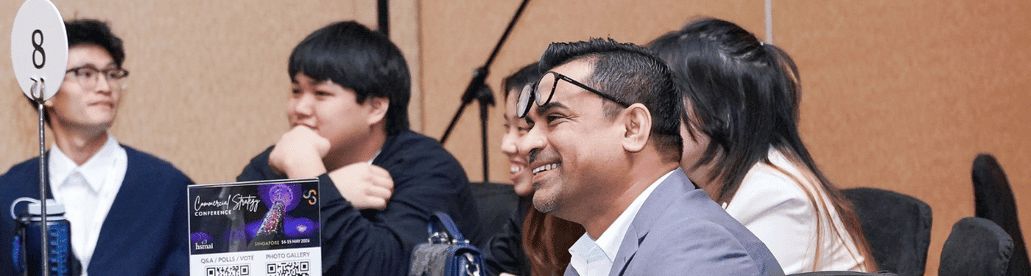
This paper therefore argues that foresight offers a sounder basis for building a team than either a single forecast or the experience of what has worked before. Team leaders can instead develop several plausible futures and consider what each would demand of their team. Capabilities that recur across these futures can inform decisions now, while those that belong to only one can be monitored until the direction of the industry becomes clearer. The argument draws on extant literature and on a workshop we ran at the 2026 HSMAI Commercial Strategy Conference in Singapore. The sections that follow explain why skills forecasting tends to fall short, describe the workshop as a method, report what it surfaced and close with a practical guide for running the same exercise with your own team.
DOWNLOAD THE FULL WHITEPAPER