
Beyond a MICE Venue: How Marina Bay Sands Is Designing Business Events for Impact
For years, event success was measured through familiar metrics such as attendance numbers and delegate satisfaction. While these remain important, organisers are increasingly asking a different question: What should participants think, feel or do differently after the event, and how should the event be designed to enable that change?
The role of a convention centre is evolving beyond providing space and facilitating operational delivery. Increasingly, the most successful events are not simply the ones with strong programmes, but those that are able to translate an organiser’s objectives into a coherent and intentionally designed participant journey, where every element collectively supports an intended outcome.
At Marina Bay Sands Expo & Convention Centre, this philosophy shapes everything from wellness and sustainability programmes to event design workshops and destination experiences.
Wellness as a Driver of Engagement
The business events industry has traditionally focused on content delivery. As business event programmes become denser, organisers are looking beyond content to keep delegates present and engaged throughout the day. Participant well-being is therefore becoming an important consideration in helping delegates remain attentive, retain their learnings and stay engaged.
This has elevated wellness from a delegate perk to a strategic design consideration.
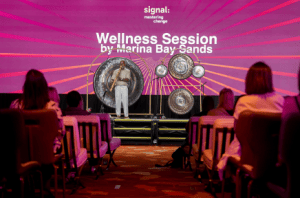
A mass Gong and Sound Bath class at PCMA Convening APAC, gave delegates dedicated time to pause and reset between conference sessions
This insight led Marina Bay Sands to introduce THRIVE in 2024, a holistic wellness programme that combines intellectual, mental and physical well-being. Combining movement-based experiences with evidence-based workshops, THRIVE helps participants heighten awareness and build resilience to sustain engagement. In 2026, the programme evolved beyond traditional breakout sessions to include large-scale activations such as Mass Gong and Sound Bath classes that can be integrated into conference agendas. These dedicated experiences give delegates the intentional time and space they need to reset and restore balance.
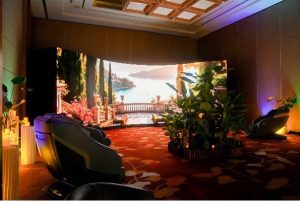

From L to R: Dedicated wellness room and complimentary evening classes like Power Vinyasa at Garden Walk
Beyond integrating wellness into the event programme, event planners can also opt for dedicated wellness rooms with calming scents, greenery and restorative amenities that are designed for reflection and recovery.
Delegates can also explore the wider Sands Expo & Convention Centre, which offers Marina Bay Sands’ Where Mind and Body Connect evening wellness programme. Featuring Power Vinyasa, Sound Meditation and Pilates, the series of classes offers a restorative way to unwind after a full day of discussions against the backdrop of Marina Bay, reflecting growing demand for business events that support both professional growth and personal wellbeing.
Making Sustainability Tangible
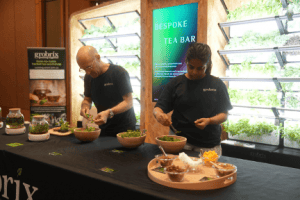
Delegates personalise tea blends by picking fresh herbs from modular hydroponic walls at Marina Bay Sands Expo & Convention Centre
The same approach applies to sustainability, which is often experienced indirectly through behind-the-scenes operations. While sustainability remains a strategic priority for many organisations, Marina Bay Sands is exploring how these practices can also become visible and participatory in the delegate experience.
To deepen engagement and make sustainability more accessible to delegates, Marina Bay Sands introduced an interactive tea bar concept at PCMA Convening APAC 2026 and The Meetings Show Asia Pacific 2026. Delegates could harvest fresh herbs grown through modular hydroponic systems within the venue to personalise tea blends and take home seedling kits, providing a direct connection to sustainable food production.
The concept has since evolved to include mocktail and bubble tea experiences, demonstrating how sustainability can become a conversation starter, a learning opportunity and a tangible connection to responsible consumption.
Applying Structured Design Thinking to Events
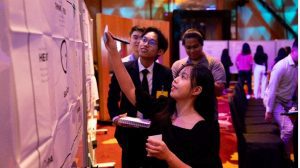
Hospitality students from Singapore Institute of Technology applied a systematic 10-step visual approach to identify and solve event challenges
Underlying many of these innovations is the belief that successful events should be designed with the same rigour for products, services and customer experiences.
Since 2023, Marina Bay Sands has partnered with Event Design Collective to train and certify more than 100 Sales and MICE Team Members in its event design methodology. The framework has since been introduced to clients around the world, from Las Vegas, Los Angeles and Sydney, to Frankfurt, London and Zurich, helping planners move beyond logistical planning to systematically define the outcomes an event should create for its participants and stakeholders.
Rather than starting with venue layouts or programme formats, the process begins with a systemic 10-step visual chart to identify and resolve pain points, then optimise events and outline costs and expected revenues along the delegate’s journey. Experiences are then prototyped, tested and refined to maximise impact. This connects an organiser’s strategic objectives more deliberately with the decisions that shape the participant journey.
This approach has expanded beyond clients to support capability-building within the industry. In 2026, Marina Bay Sands transformed its Hybrid Broadcast Studio into a collaborative learning environment for event design workshops. It also extended the methodology to students from Singapore Institute of Technology, helping nurture the next generation of event professionals and empowering them with the necessary structures and tools to create outcome-driven business events.
Extending the Experience Beyond the Venue
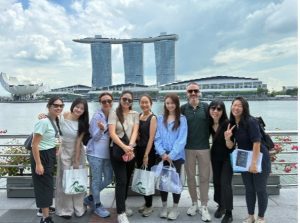 Marina Bay Sands MICE and Sales Team Members with clients during the Marina Bay Civic Immersion trail
Business events are increasingly expected to deliver a stronger sense of place while creating space for deeper reflection and learning. This presents an opportunity for destinations and venues to collaborate in new ways.
Launched in 2025, the Marina Bay Civic Immersion Trail was developed as an addition to meeting programmes to help organisers connect leadership development with destination experiences. Curated in collaboration with facilitators from AND Pte Ltd, the programme takes C-suite delegates through Singapore’s civic district while drawing lessons from the nation’s development journey and the leadership of its founding generation, and remains popular among planners today.
Rather than treating the destination as a standalone tour, the trail transforms the destination itself into an extension of the event experience, creating opportunities for reflection, discussion and learning beyond the conference agenda. It also draws on the broader Marina Bay precinct strategy, bringing together hotels, attractions, dining establishments and cultural institutions to come together to create a more integrated and distinctly Singapore delegate experience.
As delegate expectations evolve, convention centres will be defined less by the space they provide and more by the outcomes they enable. Whether through wellness, sustainability, event design or destination immersion, the common thread is intentionality. Ultimately, event design begins with a simple question: What outcomes are we trying to create?
Key Takeaways for Hotel Commercial Leaders
By Jackie Douglas, President, HSMAI Asia Pacific
Marina Bay Sands provides an impressive example of how the business events proposition is evolving. But beyond the individual initiatives, there are broader lessons here for hotel sales, marketing and commercial leaders. The opportunity is no longer simply to sell meeting space, accommodation and catering. Increasingly, it is about understanding what an organiser is trying to achieve and then designing the experience around those outcomes. From wellness and sustainability to destination experiences and structured event design, the examples in this case study point to a wider shift in MICE: from selling event space to designing event outcomes. For the Hotel leaders, there are several useful takeaways from that shift:
- Start with the outcome, not the event format.
Rather than beginning with room layouts, menus or programme formats, start by defining what the event needs to achieve for participants and stakeholders. Marina Bay Sands’ event design approach deliberately connects the organiser’s strategic objectives with the participant journey, including pain points, costs, revenue opportunities and expected outcomes. - MICE sales is moving from selling space to designing value.
The role of a venue — and by extension the hotel sales team — is becoming more consultative. The opportunity is no longer simply to sell meeting rooms, accommodation and F&B, but to help clients create experiences that support engagement, learning, networking and business outcomes. - Delegate wellbeing can be part of commercial event design.
Wellness does not need to sit outside the conference programme as an optional perk. Thoughtfully integrated pauses, wellness activations and restorative spaces can help delegates remain engaged throughout increasingly intensive event programmes. Marina Bay Sands’ THRIVE programme is a good example of wellness being treated as part of the event experience itself - Make sustainability something delegates can experience.
Sustainability can be more powerful when guests can see, touch and participate in it. The hydroponic tea-bar concept is a particularly clever example: a behind-the-scenes sustainability practice becomes an interaction, a talking point and part of the event memory. - Think of the destination as part of the event product.
Hotels and venues can extend the delegate experience beyond their own walls. Marina Bay Sands’ Civic Immersion Trail turns Singapore itself into part of the programme, linking leadership development, culture and destination storytelling rather than treating sightseeing as a separate add-on. - Experience design can create new revenue opportunities.
One of the interesting commercial implications is that better event design creates more than improved satisfaction. By mapping the full delegate journey, hotels can identify additional services, experiences and partnerships that create value for the organiser while also generating incremental revenue. The MBS methodology explicitly considers costs and expected revenue as part of event design. - The competitive advantage may increasingly be capability, not just facilities.
MBS has trained and certified more than 100 Sales and MICE team members in event design methodology. That points to an important shift: sophisticated venues may increasingly differentiate themselves through the expertise of their commercial teams, rather than relying solely on ballroom size, technology or physical infrastructure.
The next evolution of MICE is from selling event space to designing event outcomes.
Questions for Hotel Leaders
- What outcome is the organiser actually trying to create?
- Where in the delegate journey could your hotel add more value?
- Which sustainability initiatives could become visible guest experiences?
- Could wellness, local culture or destination experiences become part of your MICE proposition?
- Are your sales teams equipped to consult on event design — or primarily selling rooms and packages?
*Image credits: All photographs courtesy of Marina Bay Sands.
Badhai ho!
A fun fact: For many hotels, F&B revenue represents 30–50% of their total revenue and the focus still remains on weddings as a segment with restaurants playing second fiddle.
Unfortunately, the typical hotel F&B managers’ focus for their restaurants remains only on:
- Top line
- Number of covers
- Average cheque
This is dangerous in many ways because this is only the tip of the proverbial iceberg. The speciality restaurant manager does not panic when the 80 cover restaurant only does 6-10 covers for a weekday lunch meal period. Even if this happens on a daily basis or more frequently than not, the manager isn’t worried about his cost of raw materials, overheads and team salaries and that is a red flag right there. Just imagine the alternate scenario if this restaurant had instead been outsourced or never built. Or if rent had to be paid for the area on a square foot basis, there was a utility bill to be covered or maintenance or license fees. Guess what – the same F&B manager would have been long fired.
However, to be fair it’s not entirely his/her fault. Hotel brands are just not doing enough to train their staff on this front mainly because they too don’t see it as a red flag. The restaurant world is fast paced and competitive where there is only survival of the fittest. You have to provide a memorable culinary experience, be active on social media and have the right set of influencers recommend the restaurant. Followers, ratings, social media presence and awards are all big buzz words without which you don’t stand a chance.
The real deal: stand alone restaurants
Running a stand-alone restaurant is tough due to various reasons. Firstly, unlike restaurants in big hotels, stand-alone ones lack the support and resources needed to handle financial ups and downs and invest in important areas like equipment and advertising. Costs such as rent, utilities, and upkeep are a big part of the budget, so managing expenses well is crucial to staying profitable. Also, there’s a lot of competition in the food industry, so stand-alone restaurants must be creative, offer something unique, and always deliver great quality to keep customers coming back. Finding and keeping good staff can be hard too. Plus, dealing with rules and regulations, like getting licenses and meeting health and safety standards, adds more challenges. Overall, it takes a lot of flexibility and determination to make a stand-alone restaurant successful amidst all these obstacles.
So how does one improve F&B profitability?
Challenge No. 1: Brands insisting on multiple restaurants
Brand standards have been a bone of contention and while that needs separate focus, the current focus is on brands insisting on multiple restaurants. While this approach can enhance the overall guest experience by offering diverse culinary options under one roof, it also poses logistical and operational hurdles. Hotel brands often view in-house restaurants as integral components of their identity and guest offerings, preferring to maintain control over the dining experience from concept to execution. This insistence on internal management can limit flexibility and creativity, constraining the hotel’s ability to adapt to changing market trends and local preferences. Additionally, the overhead costs associated with operating multiple restaurants in-house, including staffing, equipment, and marketing, can strain profitability margins.
Challenge No. 2: Hotel Brands not outsourcing restaurants
Introducing the concept of outsourcing restaurants within hotel brands opens up a world of culinary possibilities. This concept is widely accepted internationally; however, in Asia, this is still a new concept and this method of optimizing efficiency has not been explored in totality. The advantages are many:
- Outsourcing restaurants brings fresh perspectives and diverse culinary experiences to hotels.
- Collaboration with external culinary experts or renowned restaurant brands enhances the authenticity and quality of the dining experience.
- Hotels can tap into specialized expertise and established reputations of external partners.
- Outsourcing alleviates the burden of staffing, training, and operational management on the hotel.
- Financially, outsourcing mitigates risks associated with fluctuating demand and reduces upfront investment costs.
- Overall, embracing outsourcing empowers hotels to deliver exceptional dining experiences, driving customer satisfaction and loyalty.
- We recommend that right from design stage plan to outsource at least one outlet which can be provided a separate entrance if required.
Challenge No. 3: Unit Economics
General Managers and Operations (Restaurants / F&B) Heads must shift their mindset to view their units as independent P&L entities. By adopting this approach, they would be able to understand the financial viability and sustainability of each restaurant. Empowering their teams to take ownership of financial performance will higher foster accountability, drive profitability, encourage strategic decision-making, cost-consciousness, and innovation tailored to the specific needs and opportunities of the unit. Look, if you are really keen to see if your restaurant is profitable then do the following apart from tracking Top line, Number of covers and Average cheque.
- Add 12–14% of top line as rent (most independents need to actually pay a minimum fixed amount too)
- Take food cost at a conservative 25–30%
- Take payroll to be 18–22%
- Utilities and maintenance at say 5–7%
- Add some costs for marketing, influencers and some salt & pepper for good measure.
If you are still surviving then kudos to you as you are doing a great job. If not then perhaps it’s time to be fired and polish that CV!
Final thoughts
Restaurants within hotels holds vast, untapped potential. These dining establishments possess the unique advantage of a built-in customer base and access to resources, yet they often remain underutilized. The question that lingers is whether these restaurants are willing to break free from conventional norms and take the leap of faith required to fully realize their capabilities.
If you are an owner and are suddenly worried then reach out and we can perhaps help. Create a speakeasy, I say – but then that’s another article, another day.
*Originally published on ehotelier.com